


Related solution
Investment management
Turning our investment legacy into
long-term growth for your portfolio.
What we are watching
Artificial intelligence (AI) remains central to the business narrative shaping corporate behavior and investor sentiment. Data sourced from Bloomberg indicates that the U.S. equity market added approximately $2.5 trillion in market capitalization in September, with roughly $1.5 trillion, or 60%, coming from the technology sector. The AI trade—meaning the market momentum and capital flowing into companies positioned to benefit from the rapid growth and commercialization of AI—which helped propel equity markets to record highs in 2024 and 2025, is now undergoing a broad repricing in October amid signals of slowing growth, rising financing costs, and broader macroeconomic headwinds.
We examine the scope of the October sell-off, its catalysts, and the key factors investors should monitor.
Figure 1: Global equity performance through October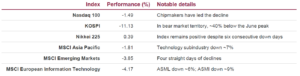 Source: FactSet / SPAR data as of October 15, 2026.
The October reversal in AI-related stocks has reverberated across major global markets. The Philadelphia Semiconductor Index (SOX) lost approximately $1.6 trillion in market value during a six-day losing streak through October 14—its longest since May 2025—falling 12% over that period. Bloomberg’s gauge of chip giants declined approximately 4.3% on October 14 alone. The sell-off has been concentrated in semiconductor hardware and AI infrastructure companies, with the steepest declines in Asian markets and among businesses most exposed to AI-related financing risk.
October has brought a steady stream of AI-related headlines, most of which have weighed on equity market sentiment. We group these developments into two interconnected categories: (i) macroeconomic factors and (ii) company-specific developments.
On the macroeconomic front, the Federal Open Market Committee (FOMC) voted unanimously in mid-September to raise interest rates by 0.25%, bringing the target range to 3.75%–4.00%, marking the first rate hike since 2023. The Fed’s Summary of Economic Projections (SEP) reinforced its hawkish stance, with upward revisions to inflation and growth forecasts and downward revisions to the unemployment rate outlook.
The October 15 Producer Price Index (PPI) release subsequently showed that September headline PPI rose 1.3% month over month, while core prices increased 0.7%; both readings were well above expectations and represented the fastest pace in four years.1 This upside surprise increases the likelihood of two additional rate hikes in 2026. Industry estimates suggest that global AI-related debt issuance will more than double to approximately $570 billion in 2026,2 intensifying concerns that the cost of financing AI capacity and infrastructure could create greater financial strain for corporations.
October has also brought unfavorable company-specific headlines across the AI ecosystem, most notably involving Anthropic and Firmus Grid. Anthropic reported $16.8 billion in third-quarter revenue, an 85% adjusted gross margin, and positive free cash flow—strong results in absolute terms, though revenue growth slowed materially from earlier in the year. While the reported growth remains exceptional, the sequential slowdown shifts investor focus toward revenue quality and margin sustainability.3
Similarly, Blackstone- and Nvidia-backed Firmus Grid Ltd. abandoned a planned approximately $30 billion initial public offering (IPO) in Australia—one of the country’s largest proposed offerings—after investors questioned the valuation relative to the company’s $51 million of fiscal 2026 revenue.4 Markets appear to be shifting from broad AI exuberance toward a greater demand for tangible evidence of financial returns, though much of the story is still unfolding.
Figure 2: Anthropic’s infrastructure $518 billion commitments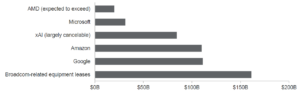 Source: Bloomberg, October 15, 2026.
Gartner, a global technology research firm, suggests that the current AI infrastructure buildout may be creating significant capital allocation risk for equity investors. By its estimates, the sector would need approximately $8.5 trillion in cumulative revenue through 2030 to support capital intensity, financing costs, and a 12% return on invested capital, yet projected AI-related revenue totals only about $3.6 trillion.5 This gap implies that more than $3.5 trillion of AI infrastructure investment could ultimately be impaired, particularly as rapid technology cycles increase the risk of asset obsolescence.
For investors, the central concern is that companies with the greatest exposure to AI infrastructure may face greater downside than diversified hyperscalers such as Microsoft, Alphabet, and Amazon, whose broader business models are better positioned to absorb market volatility. Gartner also expects industry consolidation to accelerate, with more than 80% of neocloud providers unlikely to remain independent by 2030.5
Figure 3: AI faces a $4.9 trillion revenue gap, USD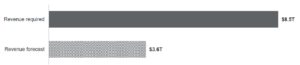 Source: Gartner, Bloomberg. Note: Forecast revenue represents Gartner’s upper-bound estimate of AI revenue attributable to data centers through 2030.
The recent market action demonstrates that the combination of elevated financing costs and a massive AI capital spending cycle is forcing investors to scrutinize tangible returns and sequential growth. Key indicators for hyperscalers, including their ability to convert backlogs into revenue and the payback periods on AI server investments, have become critical markers to watch. Anthropic’s announcement illustrates the market’s heightened focus on AI-related revenue growth, while the failed Fermus IPO suggests that investors are recalibrating valuations to better reflect actual financial performance. The infrastructure buildout has now entered its fourth year, which is also contributing to pressure on valuation multiples. Attention will next turn to third-quarter earnings from memory chip manufacturers.
Investors should also monitor the macroeconomic backdrop. An additional rate-hike scenario—now more plausible following the most recent PPI release—could compress AI valuation multiples while simultaneously increasing the cost of debt used to fund computing and infrastructure expansion. Although estimates vary widely, consensus modeling suggests that more than 33% of the buildout will be debt-financed.2 The AI financing market is already showing signs of stress, with CoreWeave serving as a prominent example. The company’s approximately 15% decline this month reflects growing credit market concern over its aggressive borrowing to fund AI infrastructure. CoreWeave’s debt has fallen to distressed levels amid plans to tap large pools of insurer capital to finance its data center buildout. Markets are now pricing in a greater than 60% probability of default for the company.6
Figure 4: CoreWeave 9.625 Senior Unsecured Note Due July 15, 2032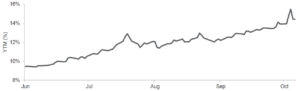 Source: FactSet / SPAR data as of October 15, 2026.
Finally, the potential for a shift in the political landscape in November adds another layer of complexity to the AI trade. Regulatory risk is no longer theoretical. Across state and local governments, investors are increasingly focused on political resistance to data center expansion, including concerns around permitting, energy consumption, and community opposition. The New York City Comptroller’s call for Anthropic to pause its IPO on AI safety grounds signals growing institutional scrutiny.7 Similarly, Texas has initiated a temporary permitting pause on new data center projects across the state, reflecting broader pushback against these facilities and their heavy use of natural resources.8 Internationally, oversight is also increasing. The European Union Artificial Intelligence Act entered its enforcement phase in August 2026, requiring companies to comply with strict transparency rules and granting the EU AI Office broad enforcement authority over the industry.9
Despite the sector-wide sell-off, companies like Taiwan Semiconductor Manufacturing Company and ASML Holding remain the foundational “picks and shovels” of global AI buildout, providing the indispensable manufacturing backbone behind the industry’s leading innovators, including companies like Nvidia, Apple, and Advanced Micro Devices. In their latest earnings updates, both companies highlighted robust demand extending through 2028 and beyond. While the path forward is unlikely to be linear, the long-term opportunity remains compelling, with few areas of the market offering a comparable combination of growth and profitability. The current repricing may ultimately strengthen the industry by separating well-capitalized leaders from companies with weaker balance sheets.
Broad-based selling across the AI complex could create attractive entry points once the volatility subsides, particularly for active managers positioned to identify durable, high-quality beneficiaries. The next phase of the equity market may reward investors who look beyond headline performance and focus on durable earnings, disciplined valuations, and high-quality businesses with sustainable competitive advantages. The CIBC Private Wealth investment team is monitoring these trends closely, with a particular focus on managing downside risk in volatile market environments.
Across our equity strategies, firmwide exposure is slightly underweight the technology sector. Within the sector, our holdings reflect our longstanding investment discipline of owning high-quality companies at attractive valuations. Our exposure to AI-related themes is concentrated largely in companies with established profitability and growing scale. More broadly, our portfolios are positioned for market leadership to broaden beyond the primary AI beneficiaries, which could create a more favorable environment for active stock selection.
On a relative basis, we believe this positioning should help our portfolios navigate market volatility. Despite what we have observed in early to mid-October, demand signals from AI users remain strong and use cases continue to expand. Companies across sectors are reporting a clear shift in AI from early experimentation toward production deployment, with agentic AI, enterprise workflow automation, and cost management emerging as the recurring themes in recent earnings calls and industry conferences.
1 Lao, H. (2026, October 15). US retail sales (September): Spending powers on. CIBC Capital Markets.
2 Reuters. (2026, June 10). Global AI debt issuance to top $500 billion in 2026, Morgan Stanley says. Reuters.
3 Vishnoi, A. (2026, October 15). Anthropic results may aid IPO but not AI trade (Corrected). Bloomberg.
4 Fioretti, J., Baigorri, M., & Hughes, A. (2026, October 15). Nvidia-backed Firmus IPO collapses as AI valuation concerns grow. Bloomberg.
5 Amin, R., Campling, N., & Bergen, M. (2026, October 15). AI race puts $3.5 trillion at write-down risk, Gartner warns. Bloomberg / Gartner.
6 Mutua, C. (2026, October 15). CoreWeave risk gauge soars, pricing in 60% chance of default. Bloomberg.
7 Hughes, A. (2026, October 15). NYC comptroller calls for Anthropic to pause IPO for AI safety. Bloomberg.
8 Haidar, E. (2026, October 10). How data centers are pushing up US power costs: Explainer. Bloomberg News.
9 Bird & Bird. (2026, September 29 or later). Frontier AI safety on both sides of the Atlantic: The White House Accord and the EU AI Act.


