


Related solution
Investment management
Turning our investment legacy into
long-term growth for your portfolio.
The midterm elections delivered a change in control of Congress, leading many to wonder what it means for financial markets. In 2027, a Republican President will serve alongside material Democratic majorities in both houses of Congress. Divided government usually disincentivizes major domestic policy changes. A Democratic Congress is unlikely to welcome proposals from the White House, and the President retains veto power over legislation passed by Congress. Policy gridlock typically reigns, and that is mostly what we expect until the 2028 election. However, the dramatic election results still carry market-relevant implications. We briefly explore some of them below.
One potential pressure point for financial markets is the need to raise the federal debt ceiling sometime next year. In past divided government scenarios, Congress has often sought to attach its legislative priorities to a debt ceiling increase, effectively daring a Presidential veto that could create instability in the financial markets. The debt limit is likely to be reached early in 2027, with the Treasury’s extraordinary cash flow measures potentially exhausted over the summer.
Opposition to data center construction proved to be a powerful factor in the election. In addition to electing many vociferous opponents of data centers, voters across the country supported 40 anti-data center ballot initiatives. The incoming Democratic congressional majority may push to curb existing tax incentives or introduce tax increases related to future construction activities. However, this is primarily a state and local issue, where Democrats also excelled on election night. The key data center states of Texas, Ohio, and Georgia will have Democratic governors in 2027.
The trend toward statewide moratoria on data center construction is likely to accelerate, thereby slowing hyperscaler capital spending. Ironically, this aligns with many investors’ wishes amid growing concerns about the impact of massive capex budgets on balance sheets and future return on investment. This may explain the strong positive reaction of those stocks in the immediate aftermath of the election. Longer term, it is important to remember that the policy agenda is unlikely to impose permanent bans on data center development but rather aim for renegotiation regarding how they are built, specifically around cost burden, energy sourcing, and environmental and labor regulation.
The AI hyper-investment cycle has had an outsized impact on economic growth (and probably inflation) in recent years. A meaningful slowdown in AI capital spending could change that dynamic. The same goes for likely Federal Reserve rate increases and reintroduction of tariffs designed to avoid Supreme Court prohibitions. At the margin, then, policy is likely to slow economic growth in 2027.
The incoming Democratic Senate majority—with at least 55 seats—will be a constraint on President Trump’s ability to get executive-level nominees confirmed. Potential nominees for market- and economically-focused cabinet and regulatory positions will need to lean toward relatively conventional choices to achieve Senate confirmation. The same applies for any openings on the Federal Reserve Board of Governors and the Supreme Court.
Presidents often pivot to foreign policy when faced with a hostile Congress or the late stages of their time in office—both of which now apply to President Trump. His decision on the Iran conflict is front and center, given the impact that higher energy prices had on the election and their effect on inflation and financial markets.
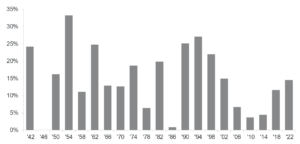
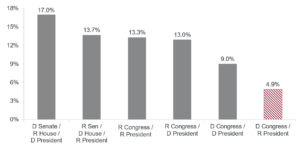
Finally, history shows that the stock market has consistently delivered positive returns in the year following midterm elections (Exhibit 1). In fact, it has risen in every such period since World War II, regardless of the election outcome. Markets welcome clarity and putting an election in the rearview mirror is a step in that direction. However, the S&P 500 has historically had its weakest gains with the combination of a Republican president and Democratic majorities in both houses of Congress (Exhibit 2). As always, we caution that in both politics and financial markets, history is a guide—not a guarantee.
Exhibit 1: US stock market has a strong record after midterms
S&P 500 price return, 12 months following midterm elections
 Source: Baird Strategas, November 3, 2026.
Exhibit 2: Partisan control, average annual S&P 500 performance
1933-2025, excluding 2001-2002
 Source: Strategas. Data excludes 2001-2002 due to Senator Jeffords changing part mid-2001.

