


Related solution
Investment management
Turning our investment legacy into
long-term growth for your portfolio.
A measure from the Fed suggests benign conditions
National Financial Conditions Index (Index: 0 = long-term average)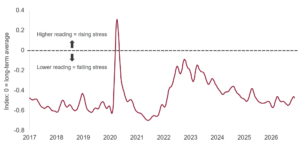 Source: Federal Reserve Bank of Chicago, Bloomberg, as of November 18, 2026.
In an investment context, “financial conditions” refer to how easy or difficult it is to obtain credit and raise capital. For more than 50 years, the Federal Reserve Bank of Chicago has tracked U.S. financial conditions through the National Financial Conditions Index (NFCI), which combines 105 indicators spanning credit spreads, liquidity, volatility, and the supply and demand for capital. Equity market prices also carry a small weight in the index.
The NFCI has been a useful real-time gauge of financial stress in the system. As the chart shows, it quickly captured the seizing up of capital markets at the onset of COVID in 2020, as well as the restoration of confidence after the Federal Reserve enacted extraordinary support measures.
Today, the NFCI points to relative stability in the U.S. financial system. However, this should not be a reason for investor complacency. Prior business cycles have been marked by unpleasant credit “surprises” that disrupted capital markets. At present, some financing techniques being used to support the buildout of artificial intelligence are drawing increased scrutiny.
Wednesday: Core PCE, the Fed’s preferred inflation measure, will be released for October. Economists expect little change in the annual inflation rate, which is running just above 3%. October new home sales will also be reported.
Thursday: Financial markets are closed for the Thanksgiving holiday.


