Related solution
Investment management
Turning our investment legacy into
long-term growth for your portfolio.
Consumer and commercial banking products and services are offered through CIBC Bank USA. Member FDIC and Equal Housing Lender. All loans are subject to credit approval. Trust services and investment products are offered by CIBC Private Wealth Management. CIBC Private Wealth Management includes CIBC National Trust Company, CIBC Delaware Trust Company and CIBC Private Wealth Advisors, Inc. (a registered investment adviser) all of which are wholly owned subsidiaries of CIBC Private Wealth Group, LLC — and the private banking division of CIBC Bank USA. Trust services and investment products are not FDIC insured, not deposits or obligations of, or guaranteed by, CIBC Bank USA or CIBC National Trust Company, and are subject to investment risk, including loss of principal.
Commercial real estate products and services offered by CIBC Bank USA and CIBC Inc.
CIBC Capital Markets is a trademark brand name under which CIBC and some of its subsidiaries, including CIBC World Markets Inc., CIBC World Markets Corp. and CIBC Bank USA, provide different products and services. Capital Markets products are not FDIC insured; not deposits or obligations of, or guaranteed by, CIBC Bank USA; and are subject to investment risk, including loss of principal.
This website is not intended for use by residents of the European Union (EU).




The CIBC Logo is a registered trademark of CIBC, used under license.
©2026 CIBC Bank USA.
A summary of the U.S. Bureau of Labor Statistics July 2025 Employment Report
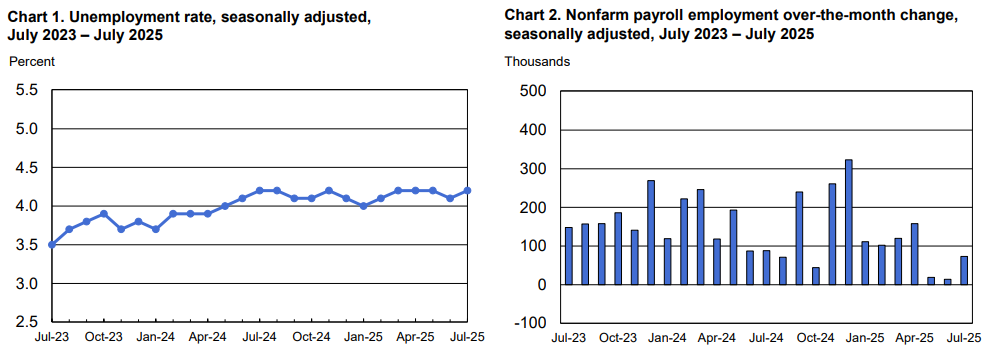
The U.S. economy added 73,000 jobs in July, according to the Bureau of Labor Statistics (BLS) survey of employers. The increase was below consensus expectations for a gain of 104,000. The prior two months were revised substantially downward by a cumulative 258,000. Employment “continued to trend up in health care and in social assistance. Federal government continued to lose jobs”, according to BLS. The number employed in manufacturing dropped to the lowest in more than three years. Over the last three months, payrolls have advanced at a monthly average of just 35,000 — the slowest trend since the pandemic.
The BLS’s survey of households reported the unemployment rate at 4.2% in July, up from 4.1% in June. The household survey showed monthly declines in both the number employed and in the labor force. However, the overall unemployment rate has been stable between 4.0% and 4.2% since May 2024. Average hourly earnings — a proxy for wage growth — rose 0.3% for the month and 3.9% vs. a year ago. Both figures met consensus estimates.
Bottom line: This is an unambiguously soft reading on the state of the U.S. job market. The payroll survey shows a near stall in job growth in recent months, while the household survey indicates declines in both employment and the size of the labor force — a sub-optimal way to keep the unemployment rate low. Market reaction has been swift and decisive. As of 9 am Eastern time, futures were pricing in an 83% chance of a Fed rate cut in September and the 10-year Treasury yield had dropped by 13 basis points to 4.26%. Equity futures were down about 1%, though that was the case prior to release of the jobs report and driven by overnight tariff news.