


Related solution
Investment management
Turning our investment legacy into
long-term growth for your portfolio.
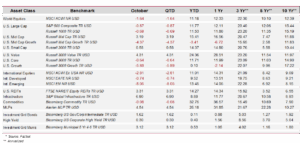
AI anxiety: Investor anxiety over AI buildout, rising debt loads, and higher yields drove risk assets lower in October. Although the S&P 500 declined only 0.8% during the month, the greater impact was felt in the Russell 3000 Growth Index, which fell nearly 6%, and the NASDAQ Composite Index, which declined 5%. Investors have become increasingly uncomfortable with the amount of debt being accumulated by hyperscalers without clear evidence of corresponding benefits. As one analyst put it, “the market is moving from rewarding spending to demanding returns.”
Hitting the pause button: The FOMC (Fed) chose to forgo a rate hike in October, preferring to see how the economy performs over the following month before its final meeting in December 2026. Although inflationary pressures remain, the Committee felt it needed additional information to help determine its stance heading into 2027. Markets showed little, if any, reaction, but the odds of a rate hike in December rose to 85% after the October meeting.
Mixed earnings picture: With about 60% of S&P 500 companies having reported by the end of October, results have been mixed. According to FactSet data, earnings growth is tracking about 30% above year-ago levels, but some cracks in tech are beginning to appear. The “Magnificent Seven” companies have collectively missed expectations this quarter, and their shares have suffered as a result.
Election uncertainty: It is well known that markets and investors do not like uncertainty, especially when it comes out of Washington. With the November 3 midterm elections taking place, we will begin to gain some sense of clarity regarding control of the House and Senate. It may take a few days before the outcome is fully clear, but the results will help establish the legislative landscape for the next two years. Historically, markets have tended to perform well in the 12 months following midterm elections, provided the outcome brings greater clarity.
Labor report: With the Fed choosing to pause on another rate increase in October, economic data over the next 45 days will be crucial. The next major release markets will be watching is the labor report, scheduled for November 6. The current consensus estimate is for payroll growth of 175,000 new jobs, which would be well above the average of just 50,000 jobs over the past three months. Such a result would allow the Fed to focus more on inflation than on labor market weakness.
Middle East tensions: Markets have been on edge over the past few months as oil prices have moved higher and tensions between Iran and the US have remained elevated. Although there has been a lull in military action, concerns have increased as the US has moved additional military support into the Gulf region in recent weeks. The President has suggested that developments could occur after the midterm elections, but for now, the situation remains highly fluid.


