


Related solution
Investment management
Turning our investment legacy into
long-term growth for your portfolio.
Consumer and commercial banking products and services are offered through CIBC Bank USA. Member FDIC and Equal Housing Lender. All loans are subject to credit approval. Trust services and investment products are offered by CIBC Private Wealth Management. CIBC Private Wealth Management includes CIBC National Trust Company, CIBC Delaware Trust Company and CIBC Private Wealth Advisors, Inc. (a registered investment adviser) all of which are wholly owned subsidiaries of CIBC Private Wealth Group, LLC — and the private banking division of CIBC Bank USA. Trust services and investment products are not FDIC insured, not deposits or obligations of, or guaranteed by, CIBC Bank USA or CIBC National Trust Company, and are subject to investment risk, including loss of principal.
Commercial real estate products and services offered by CIBC Bank USA and CIBC Inc.
CIBC Capital Markets is a trademark brand name under which CIBC and some of its subsidiaries, including CIBC World Markets Inc., CIBC World Markets Corp. and CIBC Bank USA, provide different products and services. Capital Markets products are not FDIC insured; not deposits or obligations of, or guaranteed by, CIBC Bank USA; and are subject to investment risk, including loss of principal.
This website is not intended for use by residents of the European Union (EU).




The CIBC Logo is a registered trademark of CIBC, used under license.
©2026 CIBC Bank USA.
12-month sum, Billion $
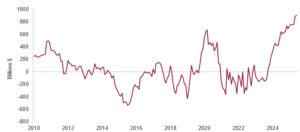
Source: Federal Reserve Bank of St. Louis, U.S. Treasury International Capital Report, as of May 31, 2026.
There are many catalysts for the nearly four-year-old equity bull market, including a growing economy, very strong corporate profits, and the AI boom. As the chart illustrates, foreign investors have been drawn to these favorable fundamentals, purchasing nearly $1 trillion more in US equities than they have sold over the past twelve months—a record.
This foreign demand may surprise some, given heightened geopolitical and cross-border tensions. US tariff policy and the conflict with Iran are deeply unpopular in many countries. But those concerns matter more to policymakers than to investors, who remain drawn to stronger US economic and earnings growth, unparalleled access to the technology sector, and exposure to the world’s reserve currency.
The chart also highlights that foreign investment flows can turn sharply negative when market conditions deteriorate. Thus, they are unlikely to support US asset prices during periods of stress and could amplify a selloff.
Wednesday: The Federal Reserve’s Open Market Committee meets to set monetary policy. Analysts expect no change in interest rates, but a vigilant tone on fighting inflation.
Thursday: The PCE price index—the Fed’s inflation focal point—is released for June. Economists are looking for a slight decline, but the resurgence in energy prices in July may make this data point less relevant.
Throughout the week: Four of the Magnificent Seven companies report second-quarter earnings: Microsoft, Meta, Apple, and Amazon.


