


Related solution
Investment management
Turning our investment legacy into
long-term growth for your portfolio.
The past decade has seen a flurry of thematic exchange-traded funds (ETFs) pop up across various segments of the market, making it increasingly tempting for investors to chase the next big theme. Thematic ETFs are defined here as funds built around a singular niche, such as Artificial Intelligence, Robotics, Clean Energy, or Genomics, that usually spans multiple sectors, rather than a broad sector, style, or market cap mandate. We analyzed more than 450 U.S.-listed thematic ETFs, including those that were liquidated, delisted, or terminated, to mitigate survivorship bias and ensure a comprehensive and unbiased assessment.
Each ETF was evaluated against a broad-market benchmark matched to its region and size. For example, U.S. large-cap themes were compared to U.S. large-cap benchmarks, and so on. Are thematic ETFs simply too new to draw conclusions from? Not really. The average ETF in our analysis is 5.1 years old, which one could argue covers a full market cycle, with some stretching back to the mid-2000s. Our findings reveal that, on average, thematic ETFs have underperformed their benchmarks every year since launch.
The evidence has become clear: the odds are against thematic ETF investors, and on average, broad-based exposures have consistently delivered better investment outcomes. In fact, most thematic ETFs carry nearly twice the market’s risk, yet offer less reward.
The averages conceal how broad the shortfall has been. In every year since launch, a majority of thematic ETFs, between 53% and 67%, underperformed their benchmark (Exhibit 1). There wasn’t a single year where more than 47% beat the broad market exposures they were marketed to outperform. Rather than a few disappointments among many successes, it is in fact the opposite: the typical fund is a laggard, year after year.
Exhibit 1: The proportion of thematic ETFs under- and outperforming their benchmark, and average market beta, by year since launch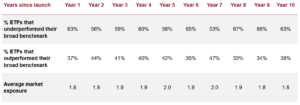 Source: FactSet; ETFs.com as of August 31, 2026.
Had thematic ETFs offered a truly differentiated route into their themes, their underperformance might be easier to rationalize. Instead, the average fund carried a market beta close to 1.9, meaning investors took on nearly twice the volatility of the broad market. In a period when markets generally rose, such a sensitive strategy would be expected to outpace its benchmark. Instead, it consistently lagged, offering less upside despite heightened risk exposure.
The crux of the issue stems not from the merits of the underlying themes themselves, but from the timing of product launches. Typically, a theme becomes an ETF only after it has attracted significant investor attention and the stocks involved have experienced a strong run-up. By the time the ETF is listed, investor hype and valuations are near their peak, leaving the ETF investor to buy in at the most expensive entry point.
On average, thematic ETFs have produced negative excess returns every year following launch, averaging roughly -3.3% per year when measured against their broad-market benchmarks (Exhibit 2). The penalty is greatest in the first year, at -6.4%, and the pattern of underperformance persists as themes gradually re-rate.
Exhibit 2: Thematic ETFs have trailed their benchmarks every year since launch, Average excess return of Thematic ETFs against their broad market benchmark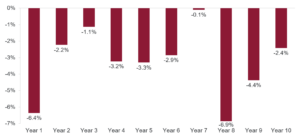 Source: FactSet; ETFs.com as of August 31, 2026.
This trend is supported by Ben-David, Franzoni, Kim and Moussawi’s 2023 academic paper, Competition for Attention in the ETF Space, which found specialized ETFs underperformed by about 3.2% annually, and newly launched ones by roughly 6% per year over their first five years. They attribute this to the overvaluation of the ETF’s holdings at launch rather than fees. Our analysis, drawn from a broader and more recent sample, reaches nearly identical conclusions.
The takeaway is not that thematic investing lacks merit, but that the thematic ETF has proven a poor vehicle for owning those themes. Broad-market exposures have delivered similar upside, with lower cost and risk, and without the elevated odds of fund closure that come with narrow products. The launch of a new thematic ETF may be better interpreted as a sign that the theme is already crowded and expensive, rather than a fresh investment opportunity.


