


Related solution
Investment management
Turning our investment legacy into
long-term growth for your portfolio.
Consumer and commercial banking products and services are offered through CIBC Bank USA. Member FDIC and Equal Housing Lender. All loans are subject to credit approval. Trust services and investment products are offered by CIBC Private Wealth Management. CIBC Private Wealth Management includes CIBC National Trust Company, CIBC Delaware Trust Company and CIBC Private Wealth Advisors, Inc. (a registered investment adviser) all of which are wholly owned subsidiaries of CIBC Private Wealth Group, LLC — and the private banking division of CIBC Bank USA. Trust services and investment products are not FDIC insured, not deposits or obligations of, or guaranteed by, CIBC Bank USA or CIBC National Trust Company, and are subject to investment risk, including loss of principal.
Commercial real estate products and services offered by CIBC Bank USA and CIBC Inc.
CIBC Capital Markets is a trademark brand name under which CIBC and some of its subsidiaries, including CIBC World Markets Inc., CIBC World Markets Corp. and CIBC Bank USA, provide different products and services. Capital Markets products are not FDIC insured; not deposits or obligations of, or guaranteed by, CIBC Bank USA; and are subject to investment risk, including loss of principal.
This website is not intended for use by residents of the European Union (EU).




The CIBC Logo is a registered trademark of CIBC, used under license.
©2026 CIBC Bank USA.
A contrast to the government's borrowing binge
Consumer balance sheets are strong
Household liabilities as a percent of net worth
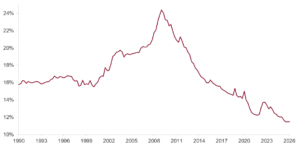
Source: Federal Reserve Financial Accounts of the United States, as of March 31, 2026.
Much attention has recently focused on the weak state of federal finances. American families, however, appear to be in better shape. Household assets have risen sharply, driven largely by higher home prices and equity values. At the same time, most Americans have taken a more disciplined approach to borrowing since the Global Financial Crisis.
The chart shows consumer liabilities, or debt obligations, as a share of household wealth. The sharp decline suggests that the consumer sector of the economy is less leveraged than in the past. In aggregate, the US household balance sheet is healthy.
That said, this positive picture of household wealth contrasts sharply with today’s very low consumer confidence readings. The chart data is weighted toward households with greater accumulated wealth, whereas consumer sentiment surveys reflect a broader cross-section of the population. In addition, surveys measure perceptions rather than actual behavior.
What we’re watching this week
Thursday: The European Central Bank meeting is widely expected to conclude with a 25-basis-point rate hike in response to recent higher inflation readings.
Throughout the week: Key US inflation indicators: the New York Fed’s 1-year inflation expectations survey (Tuesday), the August PPI release (Thursday), and the August CPI release (Friday). These will be important data releases ahead of next week’s FOMC meeting.


