


Related solution
Investment management
Turning our investment legacy into
long-term growth for your portfolio.
Consumer and commercial banking products and services are offered through CIBC Bank USA. Member FDIC and Equal Housing Lender. All loans are subject to credit approval. Trust services and investment products are offered by CIBC Private Wealth Management. CIBC Private Wealth Management includes CIBC National Trust Company, CIBC Delaware Trust Company and CIBC Private Wealth Advisors, Inc. (a registered investment adviser) all of which are wholly owned subsidiaries of CIBC Private Wealth Group, LLC — and the private banking division of CIBC Bank USA. Trust services and investment products are not FDIC insured, not deposits or obligations of, or guaranteed by, CIBC Bank USA or CIBC National Trust Company, and are subject to investment risk, including loss of principal.
Commercial real estate products and services offered by CIBC Bank USA and CIBC Inc.
CIBC Capital Markets is a trademark brand name under which CIBC and some of its subsidiaries, including CIBC World Markets Inc., CIBC World Markets Corp. and CIBC Bank USA, provide different products and services. Capital Markets products are not FDIC insured; not deposits or obligations of, or guaranteed by, CIBC Bank USA; and are subject to investment risk, including loss of principal.
This website is not intended for use by residents of the European Union (EU).




The CIBC Logo is a registered trademark of CIBC, used under license.
©2026 CIBC Bank USA.
Huge annual deficits and rising debt look unsustainable
Net interest costs as percent of government revenue, rolling 12-month average
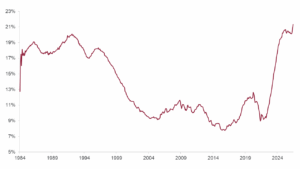
Source: US Department of Treasury Monthly Treasury Statement, as of June 30, 2026.
There are many striking statistics about the US government’s fiscal position, and few inspire confidence. Since 2023, annual deficits have ranged from $1.5 trillion to $2 trillion, and 2026 is likely to be similar. Cumulative federal debt now exceeds the size of the economy and is projected to rise to 120% of GDP by 2036.* Twenty years ago, that figure was less than 40%.
The chart highlights one consequence of the borrowing surge. For every dollar the Treasury collects, 21 cents goes toward interest payments to bondholders. That share has doubled over the past three years, reflecting both increased issuance and higher interest rates. In dollar terms, interest on the debt now exceeds the entire defense budget.
Ongoing fiscal deterioration in the public sector is a material risk. Rising debt issuance could push interest rates higher. Longer term, a government unable to bring its finances under control may favor inflationary policies to reduce the real value of its obligations. None of these outcomes would be favorable for equity or fixed income investors.
Tuesday: July data on housing starts and pending home sales will be released. Housing activity has remained soft so far in 2026.
Wednesday: The Federal Reserve will release the minutes from its late-July FOMC meeting. Investors will look for context on the split interest rate decision. A majority favored no change, while three members voted for an increase.
Throughout the week: Major retailers, including Walmart and Home Depot, will report fiscal second-quarter earnings. Management commentary often provides insight into consumer sentiment and behavior.
*Projections from Congressional Budget Office.


