


Related solution
Investment management
Turning our investment legacy into
long-term growth for your portfolio.
Consumer and commercial banking products and services are offered through CIBC Bank USA. Member FDIC and Equal Housing Lender. All loans are subject to credit approval. Trust services and investment products are offered by CIBC Private Wealth Management. CIBC Private Wealth Management includes CIBC National Trust Company, CIBC Delaware Trust Company and CIBC Private Wealth Advisors, Inc. (a registered investment adviser) all of which are wholly owned subsidiaries of CIBC Private Wealth Group, LLC — and the private banking division of CIBC Bank USA. Trust services and investment products are not FDIC insured, not deposits or obligations of, or guaranteed by, CIBC Bank USA or CIBC National Trust Company, and are subject to investment risk, including loss of principal.
Commercial real estate products and services offered by CIBC Bank USA and CIBC Inc.
CIBC Capital Markets is a trademark brand name under which CIBC and some of its subsidiaries, including CIBC World Markets Inc., CIBC World Markets Corp. and CIBC Bank USA, provide different products and services. Capital Markets products are not FDIC insured; not deposits or obligations of, or guaranteed by, CIBC Bank USA; and are subject to investment risk, including loss of principal.
This website is not intended for use by residents of the European Union (EU).




The CIBC Logo is a registered trademark of CIBC, used under license.
©2026 CIBC Bank USA.
A summary of the U.S. Bureau of Labor Statistics February 2025 Employment Report

The U.S. economy added 151,000 jobs in February according to the Bureau of Labor Statistics (BLS) survey of employers. The increase was slightly below expectations for a gain of 160,000. Job gains in the prior two months were revised lower by 2,000. The economy added 199,700 jobs on average over the trailing 3 months versus a 198,700 average at the end of 2023. The February survey was completed prior to most of the recent announcements of Federal job cuts. Non-postal service Federal jobs fell by just 6,700 during the survey period. Education and health care sectors added 73,000 during the month and remain the most consistent contributors to U.S. employment gains. Retail and Leisure & Hospitality sectors saw small reductions in payrolls.
The BLS’s survey of households reported an increase in the unemployment rate to 4.1% in February from 4.0% in the prior month. The size of the U.S. labor force decreased by 385,000 while the survey of households revealed an increase in the number of unemployed individuals by 203,000. Differences between the surveys of companies and individuals was unusually wide in February.
Average hourly earnings — a proxy for wage growth — rose 0.3% for the month and 4.0% vs. a year ago. The monthly data matched consensus expectations. The 3-month annualized rate of wage growth decelerated to 3.6% from 4.0% in the prior month.
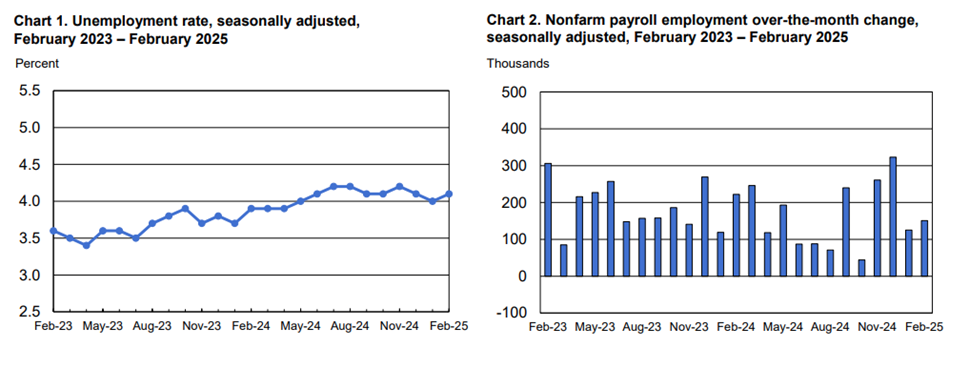
Source: Bloomberg, US Bureau of Labor Statistics.
Bottom line: February’s data provided little new information on the economy and may be the last report we see prior to an expected increase in volatility in the Federal Government sector. Wages remain on a gradual pace of deceleration. Private sector growth appears steady heading into potential public sector disruptions. Markets have been building in expectations for softer growth and currently discount 3 rate cuts from the Federal Reserve (Fed) by the end of the year. Equity futures were slightly weaker, and credit markets had a moderately positive tone following the report.


