




Related solution
Investment management
Turning our investment legacy into
long-term growth for your portfolio.
Recent months have proven a useful reminder that energy markets can absorb major shocks for a time, but not without consequences. Despite significant disruption in the Middle East and concerns around key export routes, oil prices did not move as sharply or as persistently higher as many expected. The main question now is whether the factors that helped stabilize the market can continue to do so long-term. Crude oil is a significant resource, but it remains highly sensitive to geopolitical developments. Is there a more durable opportunity in energy?
At first glance, the relative stability in oil prices through the second quarter was somewhat surprising. The backdrop included meaningful disruption to global energy trade flows, particularly around routes that are central to crude oil, refined products, and liquefied natural gas (LNG) exports. Under normal circumstances, a disruption of that scale might have pushed prices materially higher.
Two factors appear to have helped absorb the shock (Exhibit 1). First, the U.S. was able to increase exports, supported by existing inventories and strong export capacity. Second, China reduced imports and relied more heavily on previously accumulated inventories rather than continuing to buy at prior levels. Together, those adjustments gave the market enough flexibility to manage through the disruption without a more severe price response. However, the fact that the market adjusted does not necessarily mean the underlying risk has gone away.
Exhibit 1: US/China net imports/exports of crude oil and refined products, 30-day average, mb/d
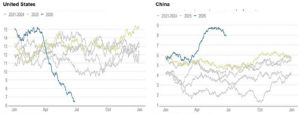
Source: MS, July 2026. mb/d = million barrels per day.
The real issue is sustainability. The U.S. is well positioned as an energy exporter, but it cannot keep increasing exports at the same pace indefinitely. Likewise, China can draw on inventories for a period of time, but that is not a permanent solution. In other words, the global energy system may have had enough cushion to absorb one episode of disruption, but it may be less equipped to do so again if supply interruptions persist or intensify. That suggests oil markets could be vulnerable to renewed volatility, particularly if geopolitical tensions worsen or critical export routes face additional strain.
At the same time, the outlook for crude oil does not necessarily point to a sustained surge in prices. Outside of a more severe geopolitical event, the market still appears reasonably supplied in the near term. Global demand growth for oil also looks more modest than it once did, with efficiency gains, electrification, and changing patterns of energy use helping to slow the pace of growth over time. That combination may keep crude oil in a more balanced range, rather than driving a prolonged move sharply higher or lower. For investors, that means oil remains important, but perhaps less compelling as a long-duration growth story than in previous cycles.
If oil looks more range-bound, U.S. natural gas appears to have a more constructive structural backdrop. One reason is exports. The U.S. continues to expand LNG export capacity with multiple projects already approved, contracted, and under construction. Because these facilities take years to build, they create a visible pipeline of future demand that extends well into the next decade. The same logic applies to U.S. natural gas liquids, such as ethane and propane. In a world where energy security is becoming more valuable, reliability counts just as much as price for many importing countries. That could strengthen the appeal of U.S. supply in the years ahead.
Another major force is the shift underway in electricity demand (Exhibit 2). For years, power demand growth was relatively modest, but we are seeing that begin to change. A combination of industrial reshoring, digital infrastructure expansion, and especially the rapid buildout of AI-related data centers is increasing demand for reliable electricity.
Exhibit 2: US power demand (TWh)
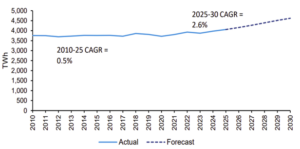
Source: Bernstein, July 2026. TWh = terawatt hour. CAGR = compound annual growth rate.
Natural gas is especially well positioned as it is one of the most scalable and dependable options for meeting incremental demand. That is particularly true in the growing market for behind-the-meter power generation (on-site or nearby power produced for a specific user rather than sourced through the broader grid), where large users such as data centers want dedicated power supply that can be deployed quickly and operated reliably. Renewables should also remain an important part of the broader power solution, particularly as utilities and large power users seek diversified generation sources and as economics, storage, and grid investment continue to improve. Rising electricity demand is likely to require both reliability and additional capacity, which creates room for natural gas and renewables to grow alongside one another.
The current energy backdrop calls for a more selective view. Crude oil absolutely still matters, but geopolitical developments can quickly affect prices and sentiment. The more durable investment case is likely to be tied to areas of the market supported by long-term demand growth and infrastructure buildout, rather than in a short-term call on oil prices alone. That includes themes such as U.S. natural gas demand growth, LNG export expansion, natural gas liquids export infrastructure, power generation tied to rising electricity demand, as well as midstream assets that support gathering, processing, storage, and export. In that sense, the energy story is becoming less about whether oil is headed modestly higher or lower over the next few quarters, and more about identifying where the most resilient sources of demand are developing.
Recent market resilience was real, but it may have depended on temporary buffers rather than a lasting resolution of risk. For investors, that points to two conclusions: oil markets remain exposed to geopolitical volatility, and the more compelling long-term opportunity may lie in U.S. natural gas and the infrastructure needed to move, export, and convert it into power. In an environment where supply security, export capacity, and electricity demand are becoming more important, those areas may deserve closer attention.

Managing Director•Lead Portfolio Manager, Energy Infrastructure

Managing Director•Portfolio Manager


