




Related solution
Investment management
Turning our investment legacy into
long-term growth for your portfolio.
Artificial intelligence (AI) has captured the attention of Wall Street and Main Street alike, driving soaring equity valuations for many technology companies tied to the theme. But while equities have been in the spotlight, the fixed income securities of these same firms have received comparatively little attention. Their debt is typically highly rated and often represents a core holding in many fixed income portfolios. Now, as the capital expenditures of leading technology companies surge to historic levels, portfolio managers and analysts are increasingly questioning what this means for the broader investment landscape and the economy going forward.
Hyperscalers are giant technology companies that build and operate massive data centers and cloud platforms that provide the computing power and storage used across the economy. The leading players include Amazon through AWS, Microsoft through Azure, Alphabet/Google through Google Cloud, Meta, and Oracle. Much like the electric utilities that built the power grid decades ago, hyperscalers are investing enormous sums today to create the digital infrastructure expected to support tomorrow’s growth.
These companies are also major customers of other well-known technology firms whose stock prices have soared in recent years. For example, they buy huge quantities of advanced computer chips from companies like Nvidia, as well as servers, networking gear, and specialized equipment for AI systems from a range of suppliers. This buying spree has helped drive up the stock valuations of these suppliers.
In contrast, the hyperscalers themselves are the ones investing heavily in building the infrastructure—and increasingly borrowing money to do so—while their core businesses of enterprise software, cloud services, advertising, and marketplaces generate steady revenue. This creates a dynamic where hyperscalers drive growth and elevated valuations for their technology hardware suppliers, while the returns on their own substantial infrastructure investments remain a future proposition.
To finance their expansion into AI and cloud services, hyperscalers have been issuing large amounts of new debt. In 2025, the main group (as previously mentioned) issued about $121 billion in bonds, more than four times the average of previous years. The pace accelerated in 2026, with $159 billion issued in just the first five months. Overall, their total debt has grown sharply, reaching hundreds of billions of dollars, and could top $1 trillion in the coming years.1
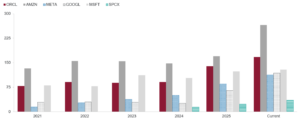
The total debt carried by these hyperscalers has steadily increased from 2021 to the present, with bigger balances in more recent years as they fund new data centers and equipment (Chart 1). This borrowing helps cover enormous spending on construction, power systems, and AI hardware, but it is also reshaping their financial picture by increasing leverage ratios. Spending more than you generate in cash could push free cash flow into negative territory over the next couple of years.
Chart 1: Hyperscaler total debt (billions)
Source: Bloomberg, July 22, 2026.
This wave of hyperscaler borrowing is having a noticeable effect on the corporate bond market. One useful concept in understanding that impact is spread duration. When investors buy corporate bonds, they typically earn a higher interest rate than they would on government bonds; that difference is known as the “spread.” The higher the spread duration, the more a bond’s price will move up or down when market conditions shift. Put simply, when credit markets move, bonds with high spread duration are more volatile.
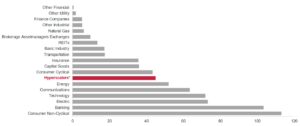
The hyperscalers stand out as some of the biggest contributors to spread duration in the US Corporate Bond Index (Chart 2). This matters because when a single group of borrowers represent such a large share of the index’s overall sensitivity to credit market volatility, their financial health and borrowing behavior can drive returns for the entire bond market. In other words, when hyperscalers are doing well, the bond market stands to benefit. However, if their credit quality were to deteriorate or spreads were to widen, the impact on bond markets would be felt broadly and swiftly.
Chart 2: US Corporate Index contributions to spread duration
Source: Bloomberg, July 22, 2026. *Includes AAPL, AMZN, GOOGL, META, MSFT, ORCL, SPCX.
Through their sizable debt and continued heavy issuance, hyperscalers now represent one of the largest and most influential segments of the investment-grade corporate bond market. As a result, for many fixed income investors, exposure to this group is not really a choice but a reality built into the index itself. On a positive note, this borrowing wave is creating real benefits for bond investors and the broader economy.
The bonds issued by these companies are highly rated, giving fixed income investors a steady stream of high-quality investment options with attractive yields. Beyond the bond market, the enormous expenditures on AI infrastructure is generating meaningful economic activity: funding construction projects, creating jobs, and driving demand across a wide range of suppliers. Companies that provide processor and memory chips, servers, power systems, and other critical equipment are seeing their revenues and stock prices rise as a direct result of hyperscaler spending. While the long-term payoff from these investments is still unfolding, the scale and ambition of this buildout suggest it could be a defining driver of economic growth well into the future.
That said, there are notable risks, particularly around credit spreads. Excessive issuance has already led to periods of wider spreads in the tech and hyperscaler segments. When several large bond deals come to market in a short timeframe, it can overwhelm investor demand, forcing companies to offer higher yields to attract buyers. This has caused temporary spread spikes of 20 basis points or more in specific issuers, leading hyperscaler bonds to underperform the broader investment-grade market.
If issuance continues at a rapid pace without matching revenue growth, it could lead to persistently wider spreads, raising borrowing costs for everyone in the sector and increasing volatility. The supply pressure is compounded by concerns over future cash flows as heavy spending on data centers may strain finances if AI returns take longer than expected to materialize. Wider spreads could also ripple through bond funds, exchange-traded funds (ETFs), and institutional portfolios that hold large positions in these names, potentially affecting overall market confidence.
Hyperscalers are now central to the digital world. They are major customers for key tech suppliers, helping drive strong performance and rising stock prices while building the infrastructure for the AI future. Their recent surge in debt issuance is funding ambitious growth but is also reshaping parts of the bond market. That creates opportunity, but it also introduces risk. In particular, supply-driven spread widening is a reminder that even strong growth stories can create pressure in credit markets.
For investors, the key will be to watch companies’ financial health and how the market absorbs continued issuance. More broadly, this trend illustrates the scale, cost and stakes of the AI boom. What is happening in hyperscaler financing today is likely to influence both equity and fixed income markets for years to come.
1 Bloomberg, July 22, 2026.


