




Related solution
Investment management
Turning our investment legacy into
long-term growth for your portfolio.
by CIBC Capital Markets - Avery Shenfeld, Managing Director & Chief Economist, and Helen Lao, Executive Director, Economics
The story is comforting: artificial intelligence (AI) will bring increased efficiencies in producing a wide range of goods and services, and the resulting cost decreases will thereby lower inflation. Quantifying those efficiency gains isn’t really possible at this early stage, but if they prove to be material, they would pave the way for further Fed rate cuts, even if the economy manages to stay near full employment.
But that story skips over an awkward but important chapter, which is where we are now, a stretch in which it’s increasingly clear that AI is on balance boosting inflation. The productivity and cost savings from AI will come later, the bills come now during a massive capital spending spree. Data centers the size of small towns are boosting construction materials, computer chip and trucking prices, and have the power appetite vast enough to push utility bills higher if joined to the grid. AI has also driven economic growth through both capital spending and consumers cashing in equity windfalls, thereby reducing disinflationary economic slack.
But just how much of current inflation can be tied to these effects? Herein, we attempt to derive a quantitative answer to that question, as a first step towards assessing where inflation will trend from here if some of these impacts will at some point begin to level off.
We begin with a look at what’s happened to prices for two inflation components where demand has been significantly lifted by AI projects: information processing equipment (computers, software and accessories) and electric power.
As an admittedly rough guide, to approximate the effect of AI on these components of the personal consumption expenditures (PCE) price index, we measure the extent to which their current inflation contribution exceeds their historical averages. That divergence from the historic trend has been increasing over the past two years (Chart 1), in synch with the growth in AI capital spending. If that’s all cause and effect, as of May, AI would have added roughly 0.3%-points to total PCE inflation.
Chart 1: Contributions to total PCE inflation by AI-related components
Estimated AI contributions to total PCE inflation by AI-related components
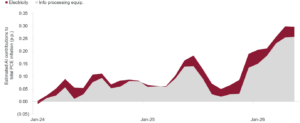
Source: BEA, CIBC calculations. Note: The estimate AI contribution is the contribution of the component to total PCE inflation minus it historical average contribution from 1991 to 2019 when total PCE inflation roughly averaged 2%.
What we haven’t yet factored in is the degree to which economic growth has been driven by AI, and led to an overheated pace to economic activity that has made the economy more inflation prone.
Adopting the approach taken by the St. Louis Fed, we accounted for the contributions of AI-related categories to US real global domestic product (GDP) growth, including investment in information processing equipment, software, research and development (R&D) and data center structures. We’ve then netted out the import contribution to meeting that demand. The result is that the contribution of AI to real GDP growth has picked up from about 0.1%-points in 2024 to about 0.3%-points in 2025, and is projected to increase to 0.4%-points in 2026.*
Consumer spending, which is partly supported by wealth gains tied to the rally in AI-related stocks, has also boosted GDP growth. We used Bloomberg’s index of AI related stocks in the S&P 500 to estimate the share of equity wealth gains coming from AI each year. Incorporating Fed research from the relationship between equity wealth gains and spending, we estimate that AI equities’ wealth effect on consumption roughly accounts for 0.2%-points of annual real GDP growth in 2024 and 2025, respectively, with a similar contribution expected in 2026 (Chart 2).
Combining the effects of AI investment net of imports with these estimates of AI equities impact on consumption, gives an estimated 0.3%-points impact on real GDP growth in 2024 which increases to 0.5%-points in 2025 and is estimated to increase to 0.6%-points in 2026 (Chart 2). That implies that AI contributions (AI investment net of imports and its approximate effect on wealth and consumption) accounts for about 10% of real GDP growth in 2024, about 23% in 2025 and is expected to increase to close to 30% in 2026.
Chart 2: AI is expected to account for about 30% of real GDP growth in 2026
AI contributions on real GDP growth
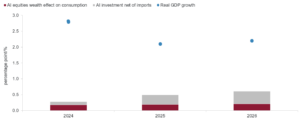
Source: BEA, Board of Governors of the Federal Reserve System, Bloomberg, CIBC calculations.
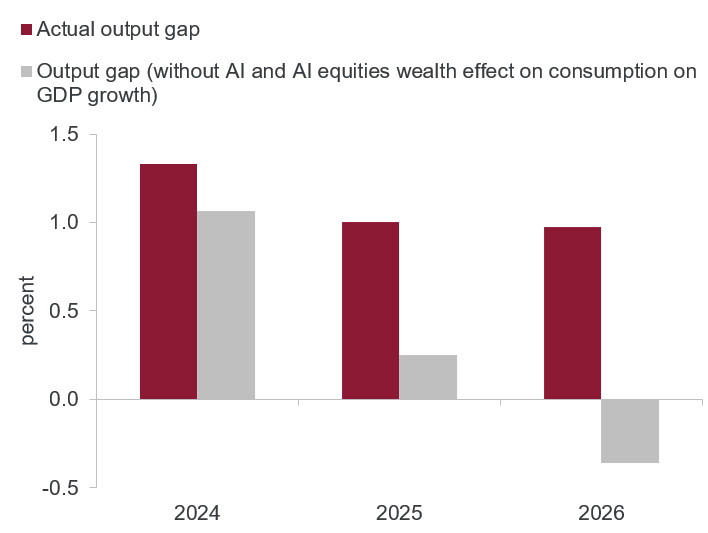
All else equal, absent that AI-driven growth, the economy would have had less excess demand and inflation. Using the Congressional Budget Office’s measure for potential real GDP, we estimate that the output gap (the difference between what the economy is actually producing and what it could produce at full capacity) is negative when AI impact are removed from GDP growth. With the estimated AI impact, the output gap is about 0.3%-points higher in 2024, 0.8%-points higher in 2025 and about 1.3%- points higher in 2026 (Chart 3, left).
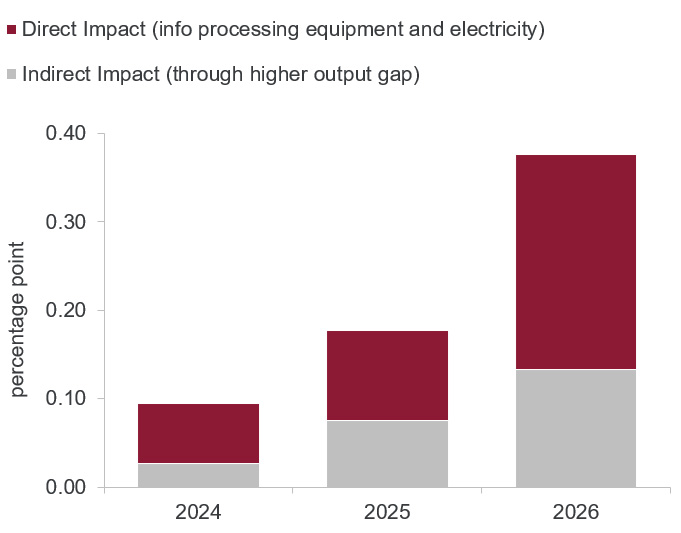
To calibrate the impact of the tighter output gap on inflation, we assume that a 1%-point increase in the output gap raises annual inflation by about 0.1%-point. Using that rule of thumb, the tighter output gap due to AI added 0.03%-points to annual inflation in 2024, 0.08%-points in 2025 rising to 0.13%-points in 2026. Combined with the estimated direct impact from AI on information processing equipment and electricity inflation, the total estimated impact from AI on annual inflation was only 0.1%-points in 2024, but has escalated to roughly 0.4%-points in 2026 (Chart 3, right).
Chart 3
|
The output gap becomes negative without AI contributions Output gap estimates with and without AI
|
AI is expected to contribute about 0.4% points to total inflation in 2026 Estimated total impact of AI on US annual inflation
|
Source: BEA, CBO, CIBC calculations. Note (L): 2026 actual output gap is based on CIBC forecast. Note (R): Annual direct impact based on monthly averages. 2026 based on average impact from January to May.
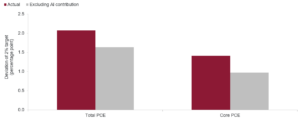
While that’s significant, stripping that lift out from PCE inflation measures shows that it’s only one of several reasons why inflation has been running above the Fed’s 2% target (Chart 4). At least in the May data, the Iran war’s impacts on both headline inflation and to core, along with sticky inflation in some non-housing services were also factors.
Chart 4: Total and core PCE inflation still above target even without AI contributions in May
Deviation from Fed’s 2% PCE inflation target as of May
Source: BEA, CIBC calculations.
Doves on the Fed will argue that the AI uptick in inflation will pass at some point. AI data center and power plant construction could still be growing in 2027, but its peak impact on inflation rates, as opposed to price levels, might be behind us at that point, particularly if its growth contribution is also more moderate. Even if the largest AI hyperscalers ramped up their spending to a full $1 trillion next year, that would be a smaller year-on-year increase than what’s been lifting the economy in 2026.
The deeper we go into next year, the more time there will be for users of AI tools to identify cost savings. Raising interest rates, and perhaps slowing the capital spending necessary to bring AI to full maturity, risks delaying those disinflationary benefits from AI, creating a dilemma for an inflation-targeting central bank.
But in the here and now, the labor market is tight, the output gap is putting upward pressure on inflation, and of the two Fed targets, it’s inflation, not full employment, that looks to be in jeopardy. Our current forecast for the Fed to remain on hold, and wait for a cooling in prices ahead, is therefore clinging to expectations for enough of a deceleration in core price measures in upcoming months to allow the Fed to stay patient. We’ll need to avoid a renewal of the Iran conflict’s pressure on oil prices in order to cool its spillovers on core inflation. We’ll also need to see tariff impacts on core goods prices begin to level off to give the Fed some breathing room. The irony is that, if the Fed does end up hiking this year, spending on a technology lauded for its potential disinflationary impacts will be one of the culprits, by adding a few decimal places to a target-topping inflation rate, but also by helping the economy stay hot enough to allow the Fed to hit its target for full employment.
*BEA and CIBC calculations.