


Related solution
Investment management
Turning our investment legacy into
long-term growth for your portfolio.
Consumer and commercial banking products and services are offered through CIBC Bank USA. Member FDIC and Equal Housing Lender. All loans are subject to credit approval. Trust services and investment products are offered by CIBC Private Wealth Management. CIBC Private Wealth Management includes CIBC National Trust Company, CIBC Delaware Trust Company and CIBC Private Wealth Advisors, Inc. (a registered investment adviser) all of which are wholly owned subsidiaries of CIBC Private Wealth Group, LLC — and the private banking division of CIBC Bank USA. Trust services and investment products are not FDIC insured, not deposits or obligations of, or guaranteed by, CIBC Bank USA or CIBC National Trust Company, and are subject to investment risk, including loss of principal.
Commercial real estate products and services offered by CIBC Bank USA and CIBC Inc.
CIBC Capital Markets is a trademark brand name under which CIBC and some of its subsidiaries, including CIBC World Markets Inc., CIBC World Markets Corp. and CIBC Bank USA, provide different products and services. Capital Markets products are not FDIC insured; not deposits or obligations of, or guaranteed by, CIBC Bank USA; and are subject to investment risk, including loss of principal.
This website is not intended for use by residents of the European Union (EU).




The CIBC Logo is a registered trademark of CIBC, used under license.
©2026 CIBC Bank USA.

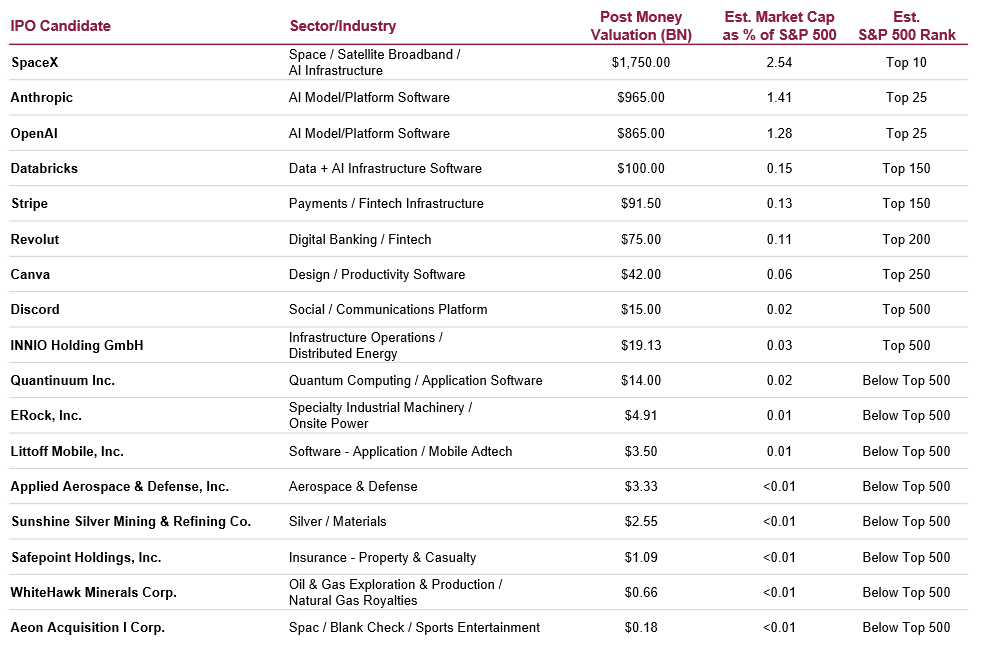
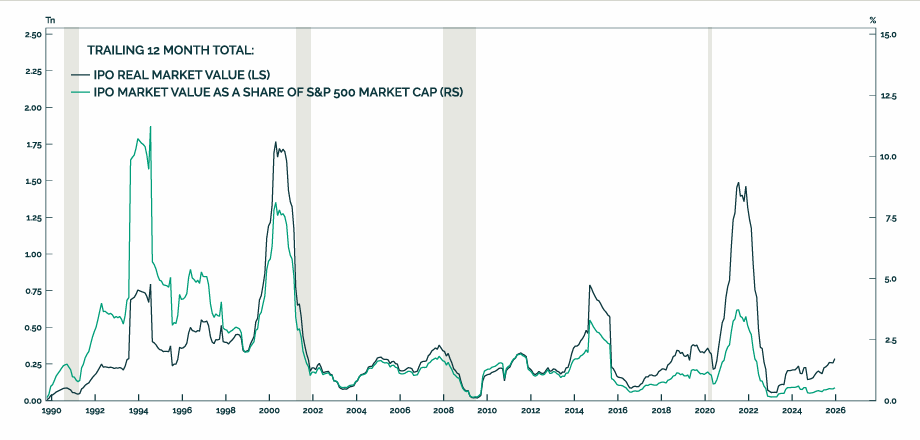
The companies headlining 2026’s initial public offering (IPO) season—SpaceX, Anthropic, and OpenAI—collectively represent over $3 trillion in private market valuation. This potential $4 trillion IPO pipeline (Exhibit 1) is not only impressive, but also unprecedented, and would be literally “off the charts” compared to any previous IPO wave (Exhibit 2).
Exhibit 1: At $4 trillion, the IPO pipeline includes some of the largest U.S. listings ever
Source: BCA Research, 2026.
Exhibit 2: IPO activity has been muted, but the coming wave could challenge past peaks
Source: BCA Research, 2026, J. Ritter, FactSet, BLS, and BCA calculations. Note: Shaded areas denote National Bureau of Economic Research-designated recessions.
This surge in mega-IPOs is not just a headline; it’s the sign of a deeper structural change in how and where value is created. As David Donabedian, CFA, CIBC Private Wealth Senior Investment Strategist, recently noted, the rise of private markets explains why recent IPO activity was a fraction of what it was in the 1990s. But that context raises a deeper question for investors: if companies are staying private longer, and some never go public at all, where is the value being created—and are you positioned to capture it?
Over the past quarter-century, the U.S. equity landscape has undergone a fundamental transformation. In 1996, there were over 7,300 listed companies in the United States; today, that number is less than 4,000, even as gross domestic product (GDP) has grown by 70%.1 Since 2009, companies have raised more capital in private markets than in public markets every single year.2 The IPO is no longer a necessity for most companies—it’s increasingly an option, and often a deferred one. Several forces are driving this shift:
This structural shift has fundamentally changed the lifecycle of corporate growth and the way investors access value creation.
The numbers tell a striking story. When Amazon went public in 1997, it had been founded just three years earlier and was valued at roughly $660 million—public investors who bought at the IPO and held have since made over 3,700 times their money. Today, the median company going public has spent more than a decade in private hands before its first trade. SpaceX alone generated more exit value through its IPO than all venture-capital-backed (VC) IPOs over the last decade combined.3 That compounding happened entirely while the company was private and before public investors got the opportunity to participate.
This year’s IPO class also offers a timely reminder that access to a listing is not the same as access to returns. Of the 48 VC-backed companies that went public in 2025, nearly 70% were trading below their first-day close by year-end, and half were below their IPO price.4 The companies that performed best shared a common trait: positive earnings before interest, taxes, depreciation, and amortization (EBITDA) before listing. Meanwhile, the broader cohort of high-growth, loss-making companies struggled to find sustained public market support, even as their private valuations remained elevated. The lesson for investors is clear: value creation is increasingly happening before companies reach the public markets, and the opportunity set for outsized returns has shifted accordingly.
The gap between private and public pricing is real. More than half of the global unicorn universe (private companies valued at more than $1 billion) carry valuations set during the pandemic boom that have never been tested by the market that followed. The repricing of that overhang—which is expected to accelerate between 2028 and 2031 as fund cycles mature—is one of the most important risks in private markets today. This presents both opportunities and challenges for private market investors and allocators. While normalization of valuations may create attractive entry points, it also demands careful scrutiny and discipline.
Concentration is now a feature, not a risk to be diversified away. The top 10 unicorns hold over 41% of the entire $8.6 trillion unicorn universe, and for most funds, “AI exposure” effectively means exposure to two or three specific capitalization tables.5 The best-performing venture funds are those deploying capital into a small number of high-conviction positions, rather than broad, index-style approaches. Manager selection, vintage year awareness, and the ability to access companies across the full lifecycle—from early-stage through pre-IPO—are what separate meaningful participation from expensive speculation.
As companies stay private longer, secondary markets and direct secondaries have become critical liquidity mechanisms for employees and early investors. While these mechanisms extend runway and reduce pressure to go public prematurely, they are not a replacement for the public markets. Once companies reach tens of billions in value, sustained growth and liquidity require public capital. The evolution of liquidity options is a key development, but ultimately, the public markets remain essential for companies seeking scale.
For investors considering private market exposure, today’s environment calls for both conviction and precision. Broad, index-style venture exposure is underperforming; selectivity in both manager choice and underlying portfolio construction is now the primary driver of outcomes. Vintage year awareness and quality assessment are crucial, especially as the repricing cycle unfolds.
The IPO excitement of 2026 is palpable, but it is best understood as the culmination of a decades-long structural shift rather than a new phenomenon. Private capital has fundamentally reshaped how companies are built, funded, and eventually brought to market. The headline numbers are impressive. The details beneath them require careful navigation and a dedicated team of experts. Investors seeking meaningful participation in this new era must balance conviction with discipline and recognize that the most consequential value creation increasingly happens before the IPO bell rings.
For more information on private markets and how an allocation may fit within your broader portfolio, please reach out to a member of your CIBC team.
1 Doidge, Karolyi, and Stulz, “The U.S. Listing Gap,” Journal of Financial Economics, 2017; Mauboussin & Callahan, “Public to Private Equity in the United States: A Long-Term Look,” Morgan Stanley Counterpoint Global Insights, August 2020.
2 Bauguess, Gullapalli, and Ivanov, “Capital Raising in the U.S.,” SEC Division of Economic and Risk Analysis, August 2018
3 PitchBook. US Geography, as of May 20,2026.
4 Mauboussin & Callahan (Morgan Stanley, 2020); PitchBook 2026 IPO Outlook for US VC; PitchBook Q1 2026 Global Unicorn Tracker
5 PitchBook, Q1 2026 Global Unicorn Tracker, May 5, 2026.
Private equity investments are speculative and involve a high degree of risk, including the potential loss of your entire investment. Such investments are generally illiquid, may be subject to long holding periods, and may not be readily marketable or transferable.
CIBC Private Wealth Management includes CIBC National Trust Company (a limited-purpose national trust company), CIBC Delaware Trust Company (a Delaware limited-purpose trust company), CIBC Private Wealth Advisors, Inc. (a registered investment adviser)—all of which are wholly owned subsidiaries of CIBC Private Wealth Group, LLC—and the private banking division of CIBC Bank USA. All of these entities are wholly owned subsidiaries of Canadian Imperial Bank of Commerce. This document is intended for informational purposes only, and the material presented should not be construed as an offer or recommendation to buy or sell any security. Concepts expressed are current as of the date of this document only and may change without notice. Such concepts are the opinions of our investment professionals, many of whom are Chartered Financial Analyst® (CFA®) charterholders or CERTIFIED FINANCIAL PLANNER™ professionals. Certified Financial Planner Board of Standards Inc. owns the certification marks CFP® and CERTIFIED FINANCIAL PLANNER™ in the U.S. There is no guarantee that these views will come to pass. Past performance does not guarantee future comparable results. The tax information contained herein is general and for informational purposes only. CIBC Private Wealth Management does not provide legal or tax advice, and the information contained herein should only be used in consultation with your legal, accounting and tax advisers. To the extent that information contained herein is derived from third-party sources, although we believe the sources to be reliable, we cannot guarantee their accuracy. The CIBC logo is a registered trademark of CIBC, used under license. Approved 4275-26. Investment Products Offered are Not FDIC-Insured, May Lose Value and are Not Bank Guaranteed.


